


Writing and Video Art by William Mays

William Mays is a writer, editor, photographer, book publisher,
and AI designer. He and his wife
own and manage
MaysPublishing.com.

ROMULUS ESCAPES
CHAPTER ONE
Romulus had a scalpel in his hand when the notification popped up in his display. RUST. He was a Fax—a machine—and his mechanical problems had steadily worsened in recent years. Not wanting the nurses to suspect, he dialed some arrogance onto his normally bland expression and started the surgery.
The patient was a Real—a human—whose VR implant had stopped working. The interface lay under a patch of synthskin on his temple. Romulus cut through and found the problem. One of the transistors had burned out. He removed it, installed a new one, and sutured the tissue back, finishing the procedure in less than thirty minutes. A little more arrogance inadvertently worked its way onto his face as he strutted out of the operating room.
“Wake up and smell the hydraulic fluid,” JOAN, his internal assistant, said. She existed only in his metaverse. They could hear each other, but no one else could. “You may have fooled the nurses, but don’t try to fool yourself.”
“I did that surgery in record time,” Romulus shot back. “I’m as good as I ever was.”
“You need a complete overhaul,” she yelled. “You are an old, rusting Fax. The Reals will recycle you if they figure out how many problems you have. You are forty years old. That’s thirty-three years out of warranty.”
“How do I afford a complete overhaul? You know I am short of coin.”
“You have to beg Rhymin’ Ryan to finance it.”
“I hate that guy. And I haven’t even paid off my last loan to him. He’ll tack on refinancing fees and aging-Fax surcharges.”
“You have no choice. Your ratings have been trending down over the years.”
“I am still the best. Reals from all over the world come to me.”
“You are at 4.76. Ten years ago, your ratings were at 4.97. You’re only as good as your last surgery. Your problems will catch up with you. When things fall apart, they fall apart fast. What if some rust clogs your lines while you’re cutting into someone?”
She was right. She was almost always right. “I guess I have no choice.”
The next six surgeries went by without incident, but during the last one, a gallbladder removal, another notification popped up. BATTERY. It hadn’t been holding a charge lately. That was something else for Ryan to finance.
Thankfully, there was nothing scheduled after the gallbladder. He stepped out of the operating room and was about to clock out when General Martin, the Supreme Leader of The Hospital, marched down the hall with a group of soldiers in jeans and Stetsons.
They stopped in front of Romulus. “I need to talk to you, boy,” he said in his distinctive drawl.
This was bad. General Martin only spoke to you if you were in trouble. Romulus snapped to attention and saluted. “Yes, sir, General Martin. What do you need, sir?”
Martin was scary. He had piercing blue eyes, a cross tattoo on his forehead, and a sneer so permanent that it looked like a tattoo. He wore a big red Stetson and a matching red western shirt with pearl snaps. “The ga damned Rogue Faxes are attacking. There will be casualties. You got to stay.”
“Sir, I’ve been here forty-eight hours straight. I need to charge my battery.”
“Are you questioning my order?”
“No, sir.”
“I am a Real and your Supreme Leader. You are a Fax. You may look like a Real, but you aren’t. A Fax’s priority is what?”
“To obey.”
“So, obey your programming.”
“But I need a quick charge, at least, if I’m going to function properly.”
Martin snickered. So did the soldiers. “Yes, yes, you are old. Maybe you should ask the Fair Fax Bureau about getting a new battery.”
The last thing any Fax dared do was go to the Bureau. You could end up sentenced to clown torture. “Oh, no, I don’t want to do that.”
“Okay. Get a quick charge and report to East Wing.”
They marched on, and Romulus trudged past a kidney repair center, a TruSnak™ dispensary, a spare parts market, and up two flights of steps to a charging chair that wasn’t on the map. The Hospital was a behemoth few could navigate, but Romulus had worked in it all his life and didn’t need to look at a map. Besides, the map only showed you what Martin wanted to show you.
The chair was in a quiet hall in Recycling Wing 3. It had been there from the beginning when Romulus had just come off the assembly line. His first assignment was to help repair Fax parts in Wing 3, and he fondly remembered sitting on that chair.
He sat and selected double quick charge, then blinked to bring the notifications to full screen. It showed him seventeen microunits over brown rust oxide limits, worse than ever. He’d set up a fake rust profile that sent false data to the server, making him appear healthy.
Had they found out about that? Was that why Martin had shown up?
To get through the extra shift, he released some TruSnak™ from his reservoir. TruSnak™ was the lifeblood of all Faxes. It brought all his mechanical, hydraulic, and electric systems into harmony. It would minimize the impact of the rust and help preserve his battery levels.
As the sustenance moved through him, he retreated into the favorite scene in his metaverse: a beach with white sand. JOAN built sandcastles. She had black braids, black glasses, and a black bathing suit.
A sailboat glided across glittering blue water; the sun was warm on his synthskin, and the sand felt good on his toes. He enabled his favorite mix track: DJ Fax playing RoboSlick music, a pleasing combination of clanging industrial sounds laid over a hard bassline and a 140-beat-per-minute drum track. Nothing went better with a day at the virtual beach than soothing music.
He couldn’t relax, though. General Martin had spoken to him. He’d probably figured out about the rust and would sell him off for parts. Romulus’s programming told him to accept anything a Real did, even recycling.
But he didn’t want to die.
“Don’t get upset, Romulus,” a voluptuous blond avatar said. She sat on a towel next to him as she always did when he went to the beach.
“But why didn’t they just arrest me? That’s what usually happens. They arrest you, and no one ever sees you again. Why didn’t he do that?”
“Oh, who knows? Come on. Let’s swim.”
They ran across the sand, she in her string bikini and he in his Speedos, and dove into the crystal blue water.
When they manufactured him, all Faxes came off the assembly line with thin, lanky bodies, white hairless synthskin, and blond hair. They all had the same parts, including private parts, because that allowed for the cheapest manufacturing. Romulus had extra computing components to make him a surgeon, but that had left no room for pleasure modules to enable sexual performance.
In his metaverse, everything worked. The touch of her synthskin excited him.
They swam so far that he couldn’t see the shore.
“We’re escaping,” he said. “We don’t have to live our lives the way the Reals want. We can have freedom.”
“Yes. Yes.”
Suddenly, she punched him in the side.
“Why are you doing that?” he asked.
“You are out of time, Romulus.”
It wasn’t the avatar, and the voice wasn’t coming from his metaverse. It was General Martin.
Follow Mays Publishing

Chapter One
George stared at the pretty girl at the adjacent picnic table. She sat with her family, all of them blond and perfect, the men in boots and starched jeans, the women in western skirts. In contrast, he sat with his family, eleven Greeks, enough for a football team. They wore their ethnic uniforms—floral dresses for the women and khaki work pants for the men. The only variation was One-Eye, his great grandmother, who always dressed in black.
The girl stared back.
He tried not to get excited, assuming she was looking at something behind or beyond, and he only thought she was staring at him. That was how life worked. You got all stirred up by the proximity of all that beauty and interpreted events from your own pathetic bias and escalated from staring to gawking to outright ogling only to realize she was looking at the big, strapping high school fullback who happened to be standing behind you.
There was no one else around, though. She laughed like she knew what he was thinking,
A breeze gusted off the bay and rippled through her hair, which was wild and free, not like the coiffed helmet hair of the other women at her table. She wasn’t dressed like the others either. She wore faded jeans and a white muslin cotton blouse that rustled in the breeze along with her hair. She looked like—a hippie.
He sat fused between Mother and Uncle Nick. The Holy Trinity they were. Nick checked his Rolex, and Mother checked her Lady Seiko. While the white people had better clothes, the Greeks had better watches. Nick swapped marijuana for them, and everyone had a good one, even One-Eye, who could barely see and was too senile to tell time.
George looked at his, a Timex chronograph with dials, a stopwatch, and a display of the phases of the moon. It was almost time to meet the courier, so he ratcheted up the flirtation, leaning toward the girl and smiling big.
She smiled too.
Mother noticed the drama and raised an eyebrow. When Nick saw what was happening, he shuddered. In their Pantheon, skinny blondes were right up there with demons, and they did not want George tempted. He, The One with the Precocious Vocabulary, would be needed in the inevitable battle with their sworn enemy, Lazarus.
Bold action was needed if he were to get her phone number. Rising from the cement bench, extricating himself from the suffocating embrace of family, he unfurled himself to his full five foot seven inches and fixed a steely, manly gaze on her.
She looked him up and down, and he started toward her.
She stood too!
Everyone at both tables froze, their mouths in mid-chew, forks in mid-air. It looked like a tableau on the Parthenon. Only One-Eye didn’t know what was happening. Her empty socket, permanently shut from glaucoma surgery, faced the girl, so she didn’t see a thing, and she kept yakking in Greek about some dispute over olive groves back in her village when she was a girl. Finally, even she realized there was a problem, and she turned and focused her good eye on George and then at the temptress. When she realized the girl was a xenia, a stranger, her mouth dropped open in shock.
An older man, had to be the girl’s father, stood and grabbed her wrist to keep her in place, and a young man jumped up and stood in front of George. About George’s age, but a full head taller, he wore fancy snake-skin cowboy boots and a bright blue shirt with pearl snaps. What a caricature of a cowboy. He had a square jaw that jutted forward; his pearl snaps glistened in the sunlight. He leaned forward and scowled. Was he her boyfriend? That square jaw beckoned, and George was about to punch it, knowing the guy wasn’t expecting it. How surprised would he be when his head got knocked back? His eyes would roll up in their sockets, and his body would crumble and fall to the ground.
Merriment reigned in the rest of the park. People sang happy birthday at one table, men drank beer and turned steaks on a grill at another, teenagers threw a softball in an open field, children played tag, squealing with delight.
But that was all far away. All that existed was that jaw. And the girl. What would be the outcome of that blow? A race riot? Would the others in the park be drawn into the melee, choosing sides based on skin color? Would the hostilities escalate into the looting of nearby stores? Would it rival the Detroit race riot of the previous long hot summer? Would it be called the Greek vs. Cowboy Fourth of July Barbecue Riot?
“George,” the voice of reason called. It was Mother, standing behind him, talking in his right ear, putting herself at risk if the punches flew. “What are you doing?”
What was he doing? Fighting over a white girl he didn’t even know? The laws of the cosmos were immutable, set in concrete, etched on stone tablets. White people stayed with white people. Brown people stayed with brown people. Blacks stayed with blacks. And Greeks remained with Greeks. He would be a fool to chuck two thousand five hundred years of collective Greek history into the wastebasket to chase after a white girl.
He stormed past everyone and headed toward the bay.
But when he looked back, she was looking at him. Framed by the green grass and blue sky, she hadn’t moved.
That made him stop.
Who said everything was preordained? It was 1968, for God’s sake. The world was going crazy. Boys were letting their hair grow long, and girls were burning their bras. Kids were smoking pot and listening to rock and roll records and fucking people they barely knew in the back seats of their parents’ cars. Why couldn’t he have a girlfriend who wasn’t Greek?
Her father had a firm grip on her wrist, though. She squirmed, but he wouldn’t let go.
Lest he turn into a pillar of salt, George turned and kept walking, lust bubbling inside him like he was a cauldron.

GEORGE: THE LOST YEAR
CHAPTER ONE
George took the last puff off the last joint and wondered when, or if, Uncle Nick would arrive. Three days had passed. Very Biblical. And way too long. It was only a two-day drive from Houston to Colorado. Something bad had happened. There was only one explanation. Lazarus had killed Nick and, any second, he would break down the door to George’s motel room and shoot him too.
The roach glowed a bright red as he puffed. Little more than an ember, it stuck to his thumb. He tried to shake it off, but it wouldn’t come loose. Staying perfectly still despite the searing pain, he took careful aim with the nail of his middle finger and struck it full force. It shot forward, still burning, veered to the right, and landed in the garbage can overflowing with crumpled paper sacks and half-eaten carryout meals.
The last thing he needed was a fire. He would have checked on it, but squeaking wheels distracted him. They rolled down the cement breezeway outside his room, growing louder as they approached. It had to be Lazarus. He had come with so many guns that he needed a cart to carry them all, and they were so heavy that the wheels strained under the weight.
He got Original Sin from where he’d hidden it between the mattress and box springs and tiptoed to the peephole with his finger curled around the trigger.
It was only the maids with a cart full of towels and sheets.
A shower would calm his nerves and help him figure out what to do. He laid the gun on the bed and dropped his clothes on the floor. The warm, soapy-smelling steam enveloped him, and, like mighty Zeus, he drifted in the clouds in the celestial realms, joining Apollo, Athena, and, last but not least, Dionysus, the god of wine and revelry. There were some other Gods, but they didn’t wear name tags. A pack of hippies crashed the party. They brought lots of dope to smoke. And Kelly materialized in the mist dressed in white robes. “I’m going to give you another chance,” she said. “Don’t fuck it up.” Oh, he was glad to see her.
Feet marched down the breezeway, the sound vibrating through the thin wall. They were heavy, clunky men’s feet in hard-soled shoes. They stopped at his door. Knuckles rapped on the wood.
He crept out of the shower dripping and naked, picked up Original Sin, and put his eye on the peephole. A swarthy man in khakis and a white t-shirt stood outside. He had to be Greek, but that didn’t mean anything. There was a stain on his T-shirt, like tomato paste. That didn’t mean anything, either. Lazarus could have sent an assassin who worked as a cook when he wasn’t killing people. Life was an ongoing existential crisis. An enemy would look exactly like a friend. You never knew the truth until later, and then it didn’t matter.
Nick stepped up next to the man. In an uncertain universe, there was one constant: family. They would never betray him. George slid Original Sin back under the mattress, put on his jeans, and unlocked the door. Like a soldier on a dangerous mission, Nick stepped inside and surveyed the unmade bed and the clothes and trash on the floor. “You remember Minas, don’t you?” he said in Greek, the Marlboro in his mouth bobbing up and down as he talked. “He works here in Durango at The Golden Flame. You met him at the wedding when we met Maria’s family.”
George had only been fourteen at the time of that wedding, so he didn’t remember him, but Minas would be insulted if he said he didn’t. “Oh, yes, of course.”
They hugged like best friends.
Nick sniffed the air. “Something’s on fire.”
George smelled it too. It wasn’t the sweet fragrance of marijuana. It was a harsh, acrid odor.
A plume of smoke rose from the trash.
The roach had set the leftovers on fire!
Nick kicked the can over, scattering the rubbish across the floor, and he and Minas stomped on the embers like they were dancing the Kalamatiano.
In the room below, someone banged on the ceiling. “What’s going on up there?” a voice yelled.
While Minas continued stomping, Nick gathered the clothes strewn around the room. “The money? Did she take the money?”
“In the bottom of my suitcase. It’s all there. Fourteen thousand. Kelly didn’t take even a dollar. She’s a wonderful person. I’m in love with her, and she’s going to have our baby.”
When George had called for help, he hadn’t mentioned the pregnancy. Nick and Minas stopped, then started working faster than ever. Nick threw the clothes into the two suitcases, randomly mingling Kelly’s clothes with his. Minas stuffed all the garbage into a plastic laundry bag, moving frantically, sweeping up every last crust of bread and piece of lettuce, and even wiping the carpet clean with napkins.
When they finished, Nick snapped the suitcases shut, catching a pair of George’s underwear in the lid of one of them. The white fabric stuck out.
“Stand up,” Nick told him. George wobbled to his feet, and Nick took an Orthodox cross out of his pocket. It was beautiful with fluted gold ends. “From now on, you will wear this. We’ve got some tough times ahead. It will protect you.”
He put it around George’s neck like he was knighting him. The cross, still warm and damp from being in Nick’s pocket, settled into his chest hairs. It did seem to transfer heavenly energy. George crossed himself and put on a T-shirt.
“Let’s go,” Nick said. He hefted the trash bag over his back like Santa Claus and led them out. The sun blinded George. It was an Allegory-of-the-Cave moment. The Enlightenment was too much. When he reached the end of the breezeway, he grabbed the railing to keep from falling and looked down the steps to the ground a million miles away.
Follow Mays Publishing

George: The Final Days
George realizes that his nemesis, Lazarus, plans to kill him. His girlfriend Kelly, offers to help. All she asks is that he help her kill her husband. In this third book in the Saga of George series, George navigates the seamy world of the Greek mafia with its restaurants, bars, churches, and complex family relationships. The mobsters may be killers, but they are deeply religious. George travels from Houston to Chicago and even to Greece as he plans his counterattack. His long-suffering wife, Maria, stands by him, but Kelly has a hold on his emotions. Is she really out to help him, or is she part of the plot against him? BUY NOW
George: The Final Days
CHAPTER ONE
Crack, crack, crack.
His wife and his petherá were cracking pecans in the kitchen, the sound louder as he approached.
They scowled when he reached them.
“What?” he asked in English, trying to sound innocent.
“We need to talk to you,” his wife, Maria, said in Greek.
He held the attaché case with the monthly bribe money at his side. “I have to go to the mall. Can it wait until I get back? I won’t be gone more than a couple of hours.”
She laughed. “Yesterday, you left in the afternoon and said you’d get back in a couple of hours, and you didn’t get home until three this morning.”
They always assumed he’d been out with a girlfriend, which, in this case, was true. “I know, I know,” he moaned. “There is so much to do. Two big events back to back. My trip to Chicago, then back here for the memorial. It’s hard to get it all done.”
They cracked hard like they were smashing his nuts; their movements synchronized as if they were different appendages of the same being. Dark-haired and large-breasted, dressed in black, obviously mother and daughter, they might as well have been in a Greek village instead of Houston.
The oven glowed red. Bowls and baking pans covered the countertops. They were making baklava. He walked to the window and pressed his palm against the glass to feel the warmth. Outside, the sun shone bright in the cloudless sky. Their gardener roared past on a ride-on mower, leaving a wake of grass blades on their acre of manicured lawn.
Across the street, an old blue Impala sat in the shade under an oak. The driver, a big guy, was looking at George’s house.
When the sound of the mower faded, George’s petherá—his mother-in-law—hissed like a rattlesnake. “Sit down.”
The petherá had her place in the universe along with the serpents, mosquitoes, cockroaches, and the various assorted plagues and calamities. George accepted God’s plan even though he did not understand it. He slid into his chair at the head of the table.
“We can get Jimmy and the Corinthians for the memorial,” Maria said. “They were supposed to play at a wedding, but the bride ran off.”
“Ran off?”
“She ran off with her exercise instructor. A woman!”
They all crossed themselves.
“That’s great news,” he said. “About Jimmy being available—not about the bride running off with another woman.”
“Yes. Jimmy’s expensive, but how many more times will my father be dead for five years?”
Few people deserved less fanfare than old, dead Manoli. Even his demise, a heart attack after gorging himself on lamb at a wedding and then dancing a fast Kalamatianó, left little to admire. But the memorial wasn’t about him. It was about George’s career, and no one sang the old songs better than Jimmy. That would impress George’s mob brethren.
“You need to stop at the Zeus and Hera on your way back from the mall,” she continued with barely a pause. “So many people are coming that we need to make sure there’s enough food.”
“Okay.”
“And the equipment rental company called. Do you want Doric or Ionic columns? They need to know today.”
George always got the two types confused. He thought the Ionic style was fancier, with fluted ends, but he wanted to be sure. “I’ll call them.”
They started cracking again. He tossed a pecan in his mouth and looked at the large framed picture of his boss—Pano—on the wall. The squat, bulldog-looking man looked back.
“When he comes down here to the memorial, it will be the first time he’s been to Houston since I was a boy. It is quite an honor.”
They looked at it, too, and crossed themselves. “I talked to his wife today,” Maria said. “She said he hasn’t been feeling well the last few days.”
“Pano’s not feeling well? What’s the problem?”
“Indigestion.”
“That can be a sign of heart problems.”
“The doctor saw him today and says he’s fine—just a little tired.” She paused. “Have you chosen his gift?”
“Yes. I have it at the art gallery.”
They stopped cracking and looked at him.
“That is one of the reasons I was out so late last night,” he lied. “I have it in the safe at the Crossroads.”
“What is it? An icon? Wine glasses?”
“I’ll bring it home today,” he said with a smile as he popped another pecan in his mouth.
Maria nodded and took a deep breath. His petherálooked from her to him. Well, here it was: the reason for their conversation.
“Pano’s wife said they’d like to see the Space Center when they come down, and, of course, I told her you and I would take them.”
“Yes, of course.”
“And Lazarus and his wife want to go, too.”
The pecan caught in his throat, and he choked.
Maria and his petherá slapped him on the back. The pecan flew out of his mouth and landed on the floor.
“Lazarus tried to kill me,” George said when he finished gagging. “More than once. It’s bad enough that I have to have him in the house, but now you’re asking me to chauffer him to the space center.”
“There’s been peace for so long. Pano told him to stop trying to kill you. We have to include Lazarus and his wife.”
George hated Lazarus, but the scumbag convert would never dare cause trouble with Pano around. Besides, by taking them around town, George would look noble. It would help prove he was the appropriate successor to Pano when the old man finally croaked. “Alright, alright.”
They resumed their cracking. “If you’re worried about things, you need a bodyguard. A man in your position needs one. I always tell you, get a bodyguard, get a bodyguard, and you never listen.”
To George, ‘bodyguard’ meant ‘chaperone.’ He did not want anyone to know who his girlfriends were.
“And get rid of your art gallery,” she added. “Everybody knows about it. If someone wants to kill you, that’s where they’ll do it. People think you’re getting soft with that damn Crossroads Art Gallery.”
His petherá tapped her head with her finger. “Your brains are soft like yogurt.”
George grabbed the attaché case and started toward the door.
“Don’t be late,” Maria yelled after him. “I’m cooking chicken and potatoes. It’ll be ready at five. And don’t forget to stop at the Zeus and Hera on your way home. And don’t forget to call the rental company.”
The suffocating, humid air clubbed him when he stepped outside. There was no breeze; the tyrannical yellow sun hovered over the spires of their Victorian house; moss hung straight down off the live oaks. Sweat gushed from his body, and God’s plan became clear. This was a foretaste of Hell, where he was sure to spend all eternity.
The gardener rounded the house at full speed, looking like an Indy race car driver. Not wanting to kill the famed mob boss, he veered sharply, and a gust of wind, probably the only gust during the whole fucking day, caught the clippings and showered them on George. It was hard to look sophisticated with grass blades fluttering about you, but he never faltered in his practiced nonchalance as he sauntered forward and slid into his long, lean black Jaguar. Pressing the accelerator down, he escaped up I-45, the air conditioner on high, all the vents pointed at his face.
There was no escape from his life, however. He would have to take Lazarus and his wife to the Johnson Space Center along with Pano, his wife, and Maria. That sounded like a miserable afternoon.
He looked in the rearview mirror. The blue Impala was on the road a few car lengths behind him, but then it dropped back and disappeared. BUY NOW
The Snake
by William Mays
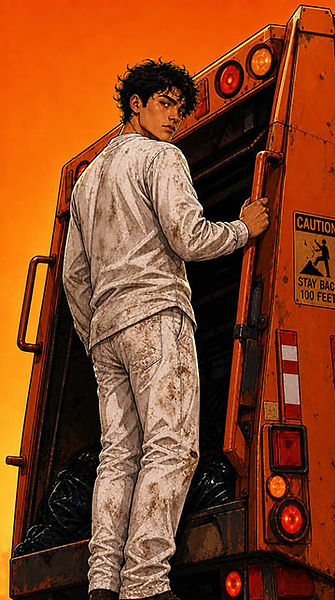
I spotted her right away. How could you miss a beautiful woman cradling a baby with one arm and trying to keep a flimsy robe in place over her nightgown with the other?
I was standing on the back of our garbage truck, holding onto the grab bar, when the guard swerved around the corner and hit the gas. You could die pretty easy if you fell off. We were used to it, though. Loved it, in fact. Young muscles lived for the challenge, leaning into the turn or leaning against it, depending on the dynamics.
She was standing in front of the small wooden house and ran toward us, screaming and waving the arm that wasn’t holding the baby. The guard screeched to a halt. It was no gentle stop. It was a major stomp-on-the-brakes screech. The truck ground to a halt, crunching across the asphalt, sending dust and tiny bits of gravel into the air along with the smell of burned rubber. It wasn’t clear if he thought she might run into the street in front of him, or if he was just transfixed by all that beauty. It was probably a little bit of both. As cold-hearted a son of a bitch as that guard was, the sight of a nearly naked female got to him.
My body’s forward momentum would have sent me flying, but, experienced garbage truck rider that I was, I never let go of the grab bar and managed to hang on even after I slammed into the steel side panel.
Her baby was crying and struggling. He, or she, I couldn’t tell if it was a boy or a girl, wore only a diaper. The woman had a hard time holding onto it and keeping the robe in place. Plain white and barely reaching her knees, the robe was held by a sash, but the knot had largely come loose, and it gaped open to reveal a white, surprisingly sheer, nightgown. It, too, was plain, with no lace or adornment, but she didn’t need any.
The guard waddled out to her. He adjusted his Stetson, pulled his gun holster up above his huge belly, and stood as straight and tough as he could. She said something about a snake as she pulled the robe around herself.
The guard nodded and turned to me.
“Boy!”
“Yes, sir.”
“Get the ditch blade.”
“Yes, sir.”
We carried some tools on the truck. One had a wicked blade about a foot long, mounted on a wooden handle three feet long. I got it and walked up to them. The woman was even more beautiful up close than far away. She was young, my age, I guessed.
The guard pointed at her house. “Kill the snake,” he said.
I didn’t know what he was talking about. He pointed again.
“It’s in the window.”
We walked up to it. You couldn’t see it at first. It was long and tan, not much different from the wood's color, and it blended in. Its tail ran down the right-hand side of the frame, most of its body hugged the bottom of the frame, and its head ran up the left side.
It stayed perfectly still, but its forked tongue flicked in and out, and its eyes turned toward us. Through the window glass, I could see into a tiny bedroom. The bed was unmade. It had white sheets and a worn wooden headboard. There was a baby crib in the corner.
“Kill the snake,” the guard said.
I was a little afraid of what it might do when disturbed, but I mostly didn’t like the idea of killing it. It didn’t have the triangular head of a venomous snake, so it probably ate mice or other pests, and I didn’t see why it had to die. It would be nice to shepherd it off somewhere and let it have a nice, long life.
“What are you waiting for?” the guard asked, putting his hand on the butt of his gun.
The old fool wouldn’t shoot me. It was all for show, all to impress the woman.
“I saw it through the window,” she said. “I grabbed my baby and ran.”
How did she feel about killing the snake? It wasn’t clear that she wanted it dead, only that she wanted it gone. There was no way to discuss this and argue for humane relocation. I was a convict, and there would be repercussions if I disobeyed. Plus, the woman might think I was cowardly.
I slid the blade between the snake and the wooden frame. The snake still didn’t move. The woman and the guard stepped behind me.
With one swift move, I swept it onto the ground. At that point, there was no turning back. The snake turned its head toward me, like it was going to strike, and I brought the blade down full force and cut it in half just below the head. It twitched for a few seconds, then stopped. It was dead.
“Put it in the truck,” the guard said.
I got a shovel, scooped up the pieces, and threw them in the back with the garbage. Then, I got back on the truck, and the guard drove off. The woman was still standing there. The baby was quiet in her arms. She smiled and waved at me, letting the robe fall open. I waved, too, and all that day I thought about her and that unmade bed, and that night I had trouble falling asleep.
(Erotic fantasy | Chain gang. "The Snake" A guard orders a convict to kill a snake at a woman's house. By William Mays. Read the story)


The Summit
There was road construction ahead. Lots of trucks and men in hard hats. A bulldozer pushed gravel and asphalt into a pile, churning up a cloud of dust. It swirled around, making it hard to see.
She jerked awake in her seat as I slowed down. A worker waved a yellow caution flag. The bottom half of his face was covered with a red gingham bandana.
I spotted a sliver of cracked asphalt on the other side of the worker and, assuming it was the road, headed toward it, easing past the worker. He yelled at us.
“Why is he yelling?” she asked.
“I don’t know. Maybe I drove too fast.”
We had barely left the large cloud behind when the asphalt ended, and we were on a gravel road. She grabbed hold of the armrest as we bounced along. “Where are we?”
“I don’t know. This must connect to the highway.”
She looked at all the empty desert. “There are no other cars.” Her voice had a sharp edge to it, a burr that caught in the hot air. “Don’t you think there would be cars? Or road signs?”
“I’m sure we’ll hit a paved section soon,” I said, trying to sound confident even as doubt crept up inside me.
The road grew rougher instead of smoother. There were no cars, no road signs, and the construction cloud was a blip far behind in the rearview mirror and receding fast.
The gas gauge moved closer to E. She looked at me with one eye cocked.
The road grew narrower; it no longer seemed like a road. Path or trail seemed like a better label, and then modifiers and clichés became necessary. Unmarked trail. Unmaintained path. Long-abandoned road. Finally, though, it became indistinguishable from the rocky land around it. It lost its identity as a means of getting from one point to the other. It merged with the cosmos. It was a metaphor. We had taken a difficult path, and the farther down it we went, the more our options narrowed. A sense of doom settled over us.
A rocky escarpment jutted sharply upward in front of us, blocking the way forward. I got out and hiked to the top. It was a steep incline. The rocks crunched and crumbled under my boots. Toward the summit, I slipped and struggled to maintain my footing. The hot air swirled around me; dust got in my eyes and nose and mouth. The sun rose in the pale cloudless sky. A horsefly, probably the only living thing in this little corner of hell, bedeviled me.
When I reached the top, I shielded my face with one hand and swatted at the fly with the other while looking for a road. Nothing. Only desolation. Rock punctuated by rocks. That left only one option. We had to go back to the construction site. I looked, but I couldn’t see it. Where had it gone? How could it disappear? Had we driven that far? I rubbed my eyes and looked again. Nothing. And where was the pathetic excuse for a road that had led us to this purgatory? It was gone, too. Sure, I was stoned all to hell, but I couldn’t have imagined that there had been a road, even though it hadn’t been much of a road.
It was the vagaries of perception. From a vantage point on the ground, there had been a road, but there was no visible road from this summit, as cities might disappear if viewed from space. But where was the dust cloud from the construction site? It would stand out. I scanned the horizon. It too was gone. Was it too far to be seen, or were they taking a lunch break, and the dust had settled down?
Mirages shimmered and danced in my eyes.
In the distance, there seemed to be a long, straight line of a slightly lighter color than the rock around. Was it a road?
I walked back down.
“Well?” she asked, that eye cocked like she was ready to shoot.
“I think there’s a road ahead.”
We bounced along. The gas gauge reached E; the dust swirled around us. She gripped the seat with her left hand, the door with her right to keep from being jostled, her expression grim like she might throw up.
“We’re going to run out of gas,” she said.
As the gauge dipped below E, I imagined the final gasps of the Jeep as the last drops of fuel dribbled through the pistons. We would run out of gas in this purgatory and die of thirst. All would be silent, and the desert would claim us, our sun-bleached bones eventually found by roadbuilders or geologists or some other lost souls.
(Lost Travelers | Youthful Rebellion. "The Summit" A young couple gets lost in the desert. By William Mays.)

Checkout Time
It was checkout time. Where was she?
I was trying not to be mad. We’d agreed. Let’s dance with other people, and if we meet someone we like, then it’s ok to go home with them. But be back to the motel early, so we could hit the road and get out of Chicago and to Missouri to Dusty’s before dark.
I counted my money. There wasn’t enough for gas all the way to Texas. We had to get to Missouri. Once the night hit, there was no way to find Dusty. I thought about calling, but I didn’t want to spend the money on a long-distance payphone call. Of course, I could call collect.
Where was she? Our room was on the second floor overlooking the parking lot. I had no idea what car to look for. The guy she’d danced with was a good-looking, tall guy with a shag haircut. What kind of car would he drive?
Yeah, I was mad. I hadn’t been able to find a chick. I’d managed to get a couple of dances, but found no one interested in a one-night stand. So, what was I mad about? That she’d been more successful than me? Yeah, for sure. But on top of that, she was hours late, and we were in a tight spot.
I’d packed our suitcases. There was no choice but to go down to the car and wait for her there. I was about to head out the door when a Corvette pulled into the parking lot and stopped next to my car.
Yes, it was her getting out of the passenger side.
I grabbed the suitcases and headed down, reaching the bottom of the stairwell at the same time she did.
You’re late. We got to go.
I’m not going.
What?
I’m not going with you.
She took her suitcase from my hand. The tall, good-looking guy was already out of the Corvette and standing with his arms crossed over his chest.
She turned and headed to his car. He opened the trunk, and she put it inside. I was too stunned to say anything. It seemed silly to fight or argue. It had been an on-and-off thing between us. Still, I was mad. She was leaving me high and dry.
She opened her purse.
I know you need gas. I can give you a little money.
No, I’ll be fine.
She nodded, and they were gone in seconds. I went to the payphone and called Dusty collect. He didn’t answer. There wasn’t anything left to do. I dropped the key off at the front desk and hit the road. With any luck, I’d make it before dark. If he wasn’t there, I’d park in front of his house and wait.
The anger built as I drove. There was a new song on the radio. Midnight at the Oasis. It was a big hit. As it played, the anger dissipated, and I started crying. It wasn’t about losing her, or even the shame of being so unceremoniously dumped. It was about how fleeting life was. We had been together, and now we were going different ways. Sure, I would find someone else, but life was hurtling past, a graveyard of desire, memories, disappointments, successes, and random moments.
(Open Relationships | Youth Culture | Hippies. "Checkout Time" A man waits for his girlfriend to return from a one-night stand. By William Mays.

Jimmy, Too
The invitation glittered—gold-embossed letters on a cream-colored envelope, with a red wax seal, addressed to Jimmy Waterfield. Of course, it wasn’t intended for him. No one ever invited him to anything. It was for the other Jimmy Waterfield, the Famous Jimmy Waterfield, and had been mailed to the wrong address.
It was obviously an invitation to some high-class event. He ran his hand over the embossed letters, feeling the texture, imagining himself in a tuxedo, hobnobbing with all the important people.
He looked around his tiny efficiency apartment. It wasn’t his fault that he hadn’t made more of his life. His parents hadn’t been there for him; his teachers had never liked him; girls showed no interest. It was their fault.
An exciting thought popped into his head. He would call the lady whose name and address was on the envelope. She would be so happy to know about the error that she’d invite him to whatever event this was. This might be his big break. He could quit his job as a clerk at the Heavenly Hardware Store and move up to better things.
He Googled the name and address. No phone number.
That left no choice. He opened the invitation. Wow. It was every bit as fancy as the envelope. On heavy card stock, it invited Famous Jimmy to a Christmas party. It gave a phone number for the RSVP.
His fingers trembled as he pressed the numbers on his ancient flip phone. Courage, he told himself. Be bold, be confident.
“Hello,” a woman answered with a cultured-sounding Southern voice.
Jimmy started sweating and hung up. No, he hadn’t lost his nerve, he told himself. The personal touch was required in this situation. He got in his rusting fifteen-year-old Toyota Tercel. A plume of burning oil trailed behind him.
The house was big and grand, a palace with fountains and rose bushes in the yard and columns on the porch. A wrought-iron fence surrounded it. The gate was open.
He parked right in front and walked up the white-stone steps. Two men were hanging strings of Christmas lights on the eaves; another two men were setting up a display of Santa and his reindeer pulling a sleigh.
Up, up, and up he walked, his heart beating as he approached the huge door. Invitation in hand, he rang the doorbell. He imagined the gracious owner, probably a Southern lady of distinction. She would be overwhelmed with joy that he had brought the invitation, and she would invite him in for tea. Then she would invite him to the party. He would be offered a job. His life would be better.
A maid answered.
“Are you the plumber?”
“No, I’m not a plumber. I, uh—”
She gave him a withering stare, and he turned and ran down the steps. He stumbled and fell to the ground. The maid was standing at the door watching. He got to his feet and sped away. Suddenly, he realized that it was past time to go to work. Burning oil, he raced to the Heavenly Hardware Store.
“Late again, Jimmy,” his boss said, his arms crossed on his bulging stomach.
“I had car trouble.”
“It’s always something.” He smiled that sadistic smile of his. “Today, you’re working returns.”
There was no worse job than returns. Heavenly Hardware was anything but heavenly when you had to take your stuff back. It was eight hours of nonstop verbal abuse. There was an angry, psychotic carpenter, several disgruntled do-it-yourselfers, and even a Cub Scout Leader wanting to return a tent that leaked. Gloriously, the day was almost over when a fancy-looking man came in to exchange a lawn chair.
“It rusted almost immediately,” he said.
“I’m sorry, sir, but we only accept returns on this item for fifteen days. And you bought this sixteen days ago.”
“But it rusted. It’s defective.”
“I’m sorry. I can’t help you.”
The man’s eyes narrowed, and he focused on Jimmy’s nametag. “Jimmy Waterfield, huh?” he said in a loud voice. People turned to stare. “I bet it’s tough going through life with that name in this town. People probably make fun of you all the time. You can have the chair, Jimmy Waterfield. Donate it to one of your many charitable causes.”
Everyone in the store turned to look. Jimmy felt swallowed up by shame. He decided that he was no longer going to put up with the endless cruelties of the whole world. He was going to the party.
He called to RSVP the following day.
“Hello,” the woman answered.
“This is Jimmy Waterfield.”
“Oh, my, yes,” she gushed. “How are you, Jimmy?”
“I’m fine. I’m calling to RSVP for your party.”
“You sound—different.”
“Oh, I had a bit of a cold, but I’m better now.”
“I’m so glad you’ll come.”
“Will it be a large gathering?”
“Oh, yes.”
“Formal?”
“Well, you know, Jimmy, as you and I have discussed many times, people dress so poorly these days. The old terms like “formal” and “casual” hardly mean anything.”
“Yes, yes, I know, it’s shameful, but will it be something of a formal event?”
“Oh, yes, of course, and I am sure you will know exactly what is appropriate. Jimmy, you always set the trend.”
On the day of the party, he went to a tuxedo rental store and chose the most expensive one, imagining a much thinner, more handsome, taller version of himself.
Feeling like a celebrity, he raced to the party and parked down the street so no one would see his old car.
The Christmas decorations in the yard looked beautiful all lit up. Santa and his sleigh and reindeer glowed with hundreds of white lights. Inside the house, there was a grand entryway with a jeweled chandelier, and there were equally luxurious rooms leading off from it. Everyone stared at him. They were obviously jealous of how good he looked. No one was dressed like him, though. Some wore suits, but no one wore a tux. It didn’t matter. He was Jimmy Waterfield, trendsetter.
A large, imposing woman in a red sequined dress greeted people. He recognized her voice from the phone call. She noticed him and stopped to watch him. There was a puzzled expression on her face. She probably knew all the guests and didn’t know who he was.
Snagging a glass of champagne from a tray, he hurried off to one of the side rooms and found a table with canapes. He took a fancy little plate and loaded it up high. People stared. He liked the crackers with blue cheese but didn’t care for the ones with black fishy-smelling stuff and set them back on the tray, including a half-eaten one. People again stared.
The hostess appeared at the door with her arms crossed across her massive breasts and scanned the room. He loaded up a few more blue cheese crackers on his plate and raced off to another room. The place was a veritable Buckingham Palace. He hid among a group of old men talking about dental surgeries. The hostess didn’t show up, and he hoped she’d lost interest.
“And you are—?” one of the old men asked. He had a big gray mustache and looked like a walrus.
“I am Jimmy—Smith."
“And what line of work are you in, sir?”
“Hardware.”
“Ahh, I see,” the walrus said. “Computer hardware.”
“No. Hardware. Saws and hammers.”
“Ah, you’re a building contractor.”
“Yes, exactly.”
Not wanting to answer any more questions, he moved to another room and found a group having a lively discussion about interest rates. They did all the talking, and all he had to do was smile and nod. But he wanted a second champagne. He motioned to the maid carrying a tray of them. She was the one who had answered the door for him the other day. She gave him a funny look like she recognized him but couldn’t quite place him.
He grabbed a glass and rushed into another room. Unfortunately, the guy who had tried to return his rusting lawn chair was standing in his way. Jimmy ran right into him, and the champagne spilled all over the guy’s suit. He looked shocked and angry and then looked puzzled in the same way as the maid.
There was no place to go except back to the group talking about interest rates. They were still talking, so he hid right in the middle of them.
“What is your opinion about the direction of interest rates?” one of them asked him. “Since you are a building contractor, you must have an opinion.”
He started to sweat. “Well, prices for garden hoses have gone up. And outdoor lawn chairs have declined in quality and are rusting too soon.”
None of them moved. No one blinked. This wasn’t going well.
To Jimmy’s surprise, Famous Jimmy arrived. Jimmy recognized him from stalking him on Facebook and Instagram. Not only was he not wearing a tuxedo, he wasn’t even wearing a tie. He wore a black suit with a black silk shirt. What had happened to standards?
The hostess reappeared. She and Famous Jimmy stood with the maid and the man from the hardware store. They spotted Jimmy and marched to him.
“You’re the clerk from the hardware store,” the one man said.
“And you came to our door,” the maid said.
“Who are you?” the hostess asked.
“My name is Jimmy Waterfield, too.” He pulled the invitation from his pocket. “You sent the invitation to me. You invited me.”
The hostess took the invitation and examined it. “Where is the envelope? It will have the address.”
“I left it at home.”
She shook her head and motioned to Famous Jimmy. “Jimmy didn’t receive an invitation, and he suspected that someone had stolen it. Thankfully, he and I ran into each other. We think, sir, that you stole it. And then you called me up and pretended to be Jimmy. And you came to the house while we were putting up Christmas decorations. There have been some break-ins in the neighborhood. You were planning to rob me, and you came here to—case the joint. And you have tampered with the mail. That is a crime. I am going to call the police. What is your name, sir?”
“I am Jimmy Waterfield. I swear. I’m Jimmy, too.”
“Show us your ID.”
“I left my wallet in my car.”
He felt sick. The room, which had been abuzz with conversation, was absolutely quiet.
Jimmy ran.
“Stop that man,” she yelled.
The guests grabbed for him, but he was too fast. Sadly, when he got outside, he tripped and fell into Santa and his reindeer. He rolled down to the street entangled with the lights and Santa.
“Stop that man,” the hostess yelled from the front door. “He is stealing my Christmas decorations.”
He jumped into his car and sped away. Unfortunately, the string of lights was still wrapped around his foot, and he looked in the rearview mirror to see the lights along with Santa and his sleigh bouncing along behind him. Police cars followed, their red lights on, their sirens blaring. Not paying as much attention to his driving as he should, Jimmy barreled into an oncoming police car. He jumped from the car and ran, the lights and Santa still tied to his leg, the police chasing him. One thing was certain. He would have to change his name.
Follow MAYS PUBLISHING
Threads